
Orthodontics in Istanbul: An Honest Guide for UK and Irish Patients
Orthodontics is the branch of dentistry that moves teeth into better positions — closing gaps, relieving crowding and correcting how the upper and lower teeth meet. It is done with fixed braces, clear aligners, or occasionally removable appliances, and it is the only treatment on this site that genuinely changes where your teeth sit rather than changing how they look.
It is also the treatment that fits dental travel worst, and this page says so before it says anything else. Teeth move slowly, on a biological timetable that no clinic can accelerate to suit a flight schedule. If you read only one section, read the one immediately below.
Can you have orthodontic treatment abroad?
Direct answer
Orthodontics moves teeth into better positions using fixed braces or clear aligners. It is the dental treatment least suited to travelling abroad, because fixed appliance treatment averages around twenty months and roughly eighteen appointments. Clear aligners are the realistic exception for suitable cases, since they need fewer visits and can be monitored remotely between trips.
The number that decides this
In a systematic review of 22 studies covering 1,089 participants, mean treatment duration with fixed orthodontic appliances was 19.9 months (95% CI 19.58–20.22), across a mean of 17.81 appointments (95% CI 15.47–20.15) (Tsichlaki, Chin, Pandis & Fleming, American Journal of Orthodontics and Dentofacial Orthopedics, March 2016, PMID 26926017).
Read that as a travel plan and the problem is obvious: roughly eighteen visits over about twenty months. Nobody flies to Istanbul eighteen times, and an adjustment appointment missed for three months is not a delay — it is a stalled tooth, a lost anchorage, sometimes a worse result than not starting.
Any clinic offering you fixed braces abroad without addressing how those eighteen appointments will happen is not describing a real plan.
Clear aligners
Removable
A series of trays changed on a schedule. Depends entirely on being worn; suits milder crowding and spacing.
Ceramic braces
Less visible
Same mechanics as metal with tooth-coloured brackets. More fragile, and usually more expensive.
Fixed metal braces
Widest range
Bonded to the teeth and adjusted in person. Handles rotations and root movements that removable appliances cannot.
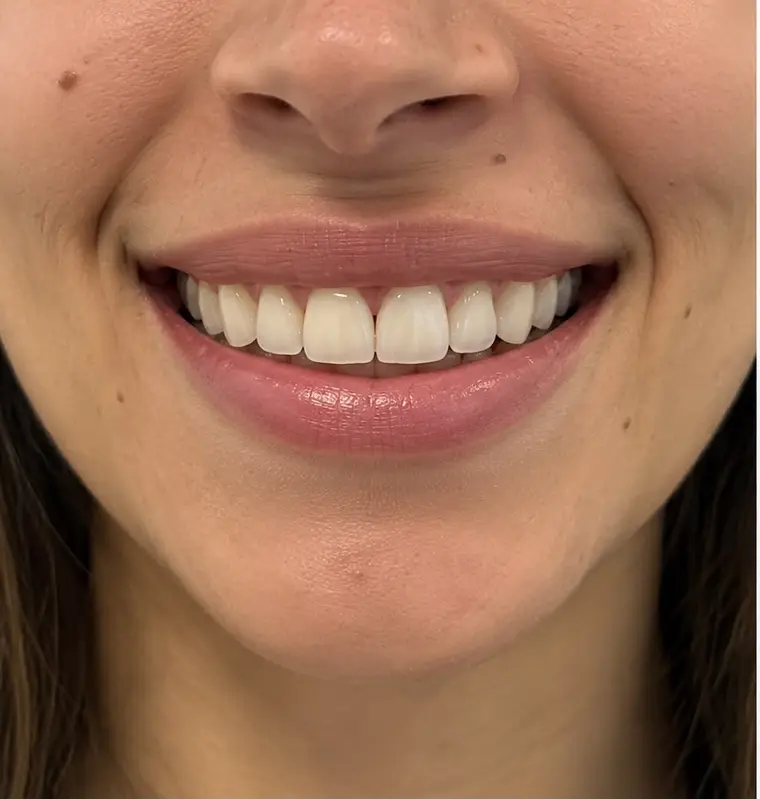
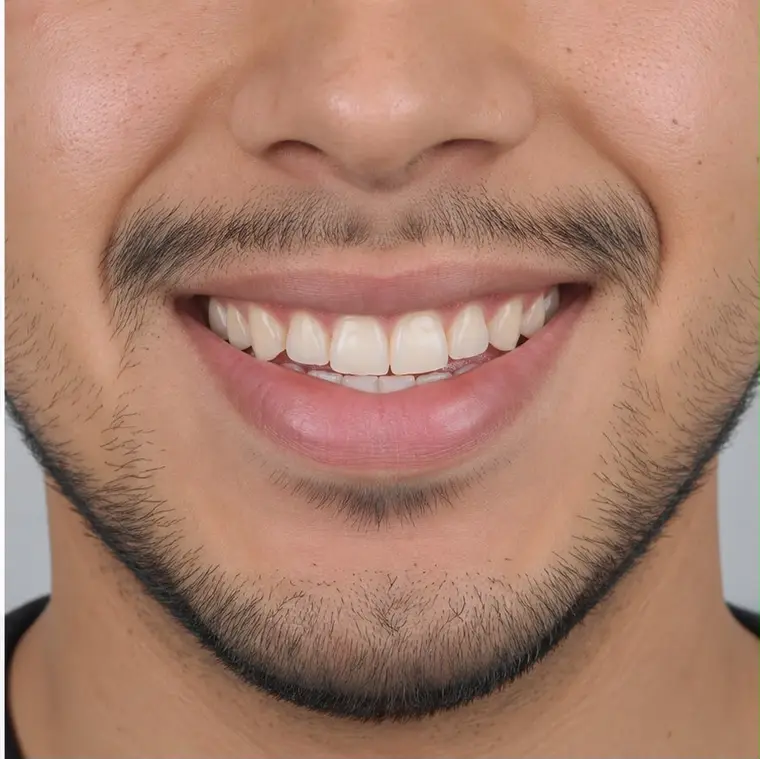
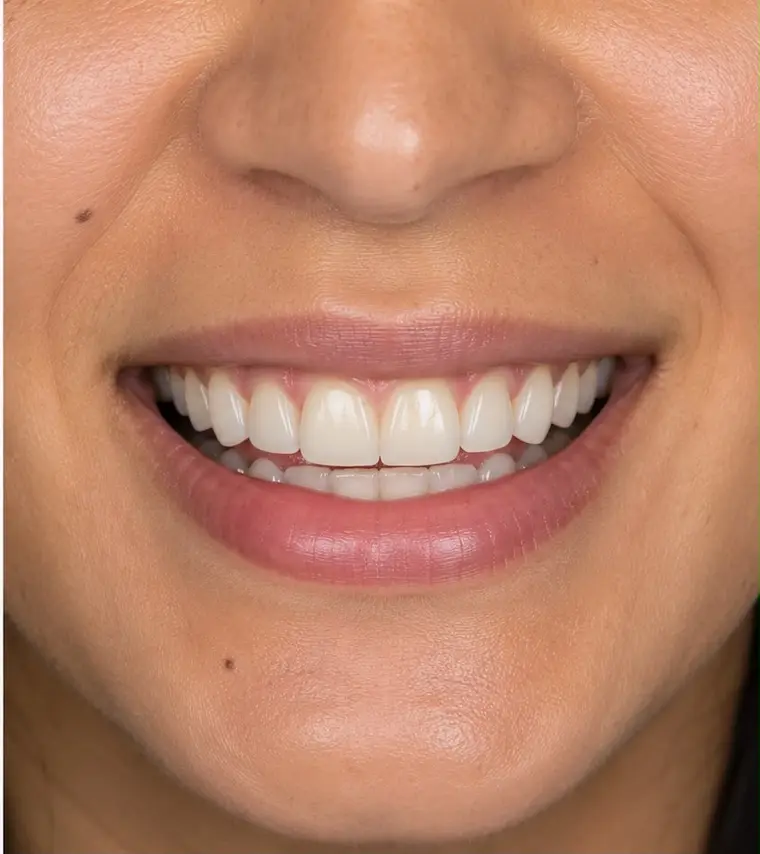
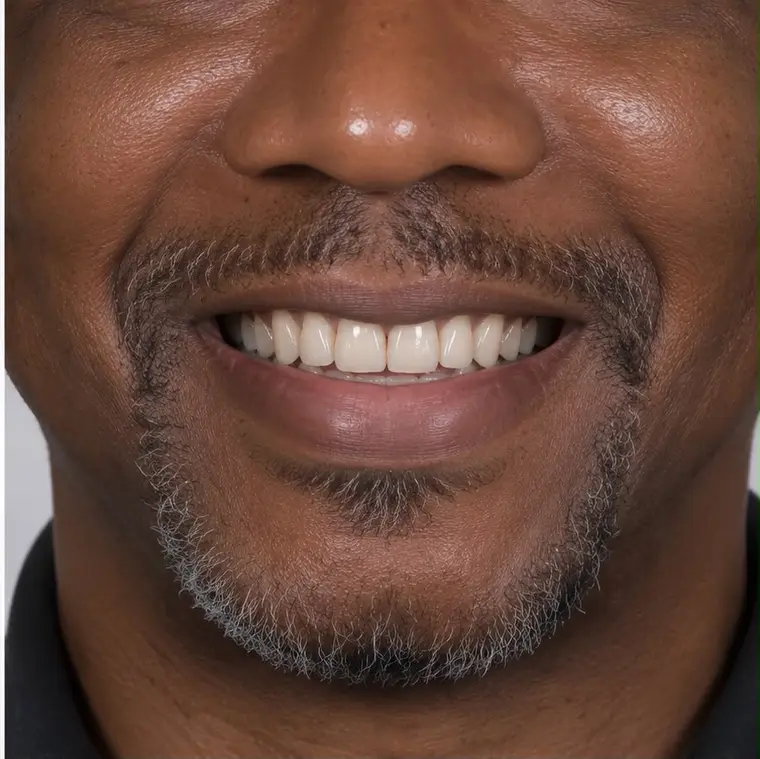
Illustrative smile images. Not patient cases.
The realistic options
Fixed braces
Brackets bonded to the teeth and connected by a wire that is adjusted at regular intervals. Fixed appliances remain the most versatile option and can treat cases aligners cannot. They are also the option that demands the appointment schedule above.
Clear aligners
A series of removable, transparent trays, each one moving the teeth a small amount. Progress does not depend on a clinician adjusting a wire in person, which is what makes them the one orthodontic modality that can realistically be combined with living in another country.
The evidence is specific about where they work. A systematic review including three randomised controlled trials, eight prospective and eleven retrospective studies found “substantial consistency among studies that the Invisalign system is a viable alternative to conventional orthodontic therapy in the correction of mild to moderate malocclusions in non-growing patients that do not require extraction”. The same review recorded limited efficacy “in arch expansion through bodily tooth movement, extraction space closure, corrections of occlusal contacts, and larger antero-posterior and vertical discrepancies”, and concluded that no clear recommendation could be made beyond non-extraction treatment of mild to moderate cases in adults (Papadimitriou, Mousoulea, Gkantidis & Kloukos, Progress in Orthodontics, September 2018, PMID 30264270).
In plain English: aligners are well supported for adults with mild to moderate crowding or spacing who do not need teeth removed. Outside that description, the evidence thins out quickly.
Retainers
Not an option so much as a permanent obligation. See the retention section below — it is the part patients most often skip and most often regret.
Who is a good candidate for orthodontic treatment abroad
Travel-based orthodontics can work when:
- You are an adult, with facial growth complete.
- Your case is mild to moderate crowding or spacing, without extractions planned.
- Your gums are healthy and any gum disease has been treated first — teeth are not moved through inflamed, actively deteriorating bone. See gum disease treatment.
- Clear aligners are clinically appropriate for your case, not merely preferred.
- You can commit to at least two trips, plus retention, plus a dentist at home who will see you in between.
- You accept that if the case does not track as planned, additional aligners or a change of approach may be needed, and that this takes more time rather than less.
Who is NOT a good candidate
This is the longest such section on this site, deliberately.
Orthodontic treatment abroad is the wrong plan if:
- You are under 18 or still growing. Growth-stage treatment is monitored closely, and timing relative to growth is part of the treatment itself. This needs a clinician who sees the patient regularly, near home.
- Your case needs fixed appliances. Roughly eighteen appointments cannot be delivered from another country. If fixed braces are the right clinical answer, the right place is where you live.
- Extractions are planned as part of the orthodontic plan. Closing extraction spaces is explicitly among the movements where aligner evidence is weakest.
- You have a skeletal discrepancy — a jaw size or position difference — that would normally be addressed with orthognathic surgery combined with orthodontics. This is a multi-year, multi-specialty pathway.
- You have active, untreated gum disease. Moving teeth through inflamed tissue with existing bone loss can accelerate that loss.
- You have untreated decay or teeth needing root canal treatment. These are dealt with before appliances go on, not after.
- You cannot commit to wearing retainers indefinitely. Then the result will not hold, and the money is being spent on a temporary effect.
You should think much harder if:
- You have been offered orthodontic treatment without a full assessment including radiographs. Aligners cannot be planned responsibly from photographs alone.
- You are being offered crowns or veneers instead of orthodonticsto “straighten” crooked teeth. Grinding down healthy teeth to make them look aligned is the single most criticised practice in dental tourism. If your teeth are healthy and merely crooked, the honest options are orthodontics, conservative bonding, or leaving them alone.
- Your main concern is the appearance of mild irregularity in your front teeth, and you do not want a two-year process. There is a legitimate shortcut, and it is not crowns — see the comparison below.
Fixed braces vs clear aligners vs composite bonding
These three are not clinical equivalents. They are the three realistic answers UK and Irish patients actually choose between, and the honest comparison includes what each one cannot do.
| Criterion | Fixed braces | Clear aligners | Composite bonding |
|---|---|---|---|
| What it does | Moves teeth into new positions | Moves teeth into new positions | Reshapes the visible surface; does not move teeth |
| Corrects the bite | Yes, the most versatile option | Within limits — weakest for occlusal contacts and larger discrepancies | No |
| Typical duration | Mean 19.9 months across 22 studies (Tsichlaki et al., AJO-DO, March 2016) | Varies by case; fewer in-person visits required | 1–2 appointments |
| Typical appointments | Mean 17.81 (Tsichlaki et al., 2016) | Fewer, and spaceable between trips | 1–2 |
| Trips to Istanbul | Not realistic | Usually 2, plus remote review | Usually 1 |
| Evidence position | Long-established across all case types | Supported for mild to moderate malocclusion in non-growing patients not requiring extraction (Papadimitriou et al., Prog Orthod, September 2018) | Anterior composite: annual failure 0–4.1%, total failure 24.1% across 1,821 restorations (Demarco et al., Dental Materials, October 2015) |
| Healthy enamel removed | None | None | Little or none in most cases |
| Reversible | Yes, teeth can be moved again | Yes | Usually yes |
| Retention needed afterwards | Yes, indefinitely | Yes, indefinitely | No, but bonding needs maintenance and repair |
| Main weakness | Appointment burden; decalcification risk around brackets if hygiene slips | Depends entirely on you wearing them as prescribed; limited for complex movements | Masks irregularity rather than correcting it; stains and chips sooner than ceramic |
| Relative cost (ranking, not a price) | Middle | Highest | Lowest |
| Best for | Any case, treated near home | Adults with mild to moderate crowding or spacing, no extractions | Someone who dislikes the look of mild irregularity and will not commit to two years |
Comparison compiled by DentVisit, August 2026. Figures describe study populations in the cited peer-reviewed sources, not individual outcomes.
Where we will argue against ourselves: for most UK and Irish patients wanting straighter teeth, having orthodontic treatment at home is the better clinical decision, and we would rather say that than sell you a plan that cannot be delivered. There are three honest exceptions. First, adults with straightforward aligner cases who are comfortable with remote review between trips. Second, patients already travelling for other treatment, where alignment is being sequenced into a wider plan. Third — and this is the one most people are actually looking for — patients whose real complaint is cosmetic rather than orthodontic, for whom composite bonding achieves in two days what they assumed needed two years. If that is you, orthodontics is the wrong page.
Why orthodontic quotes vary so widely
- Number of aligners or length of treatment. A short cosmetic alignment of the front teeth and a full-arch correction are different products sold under similar names.
- Whether refinements are included. Aligner cases frequently need a second set of trays once the first series finishes. If that is excluded, the headline price is not the price.
- Whether retainers are included, and whether replacements are.
- One arch or both. Many advertised figures cover the upper teeth only.
- Whether records, radiographs and the digital plan are included.
- Whether preparatory treatment is included — gum treatment, fillings or extractions before appliances go on.
Before comparing any two quotes, ask: how many aligners, how many refinements, one arch or two, retainers included, and what happens if the teeth do not track as planned.
- 01
Records and plan
Photographs, scans and radiographs. The plan states which teeth move, how far, and roughly how long it will take.
- 02
Appliance fitted
Braces bonded or the first aligners issued, with instructions you can follow without supervision.
- 03The long part
Adjustments
Regular reviews over months. A bracket that debonds needs a chair within days, not a flight.
- 04
Debond
Appliance removed and teeth polished. Retainers are made at this point, ideally the same day.
- 05Ongoing
Retention
Retainers checked and replaced as they wear. This is part of the treatment, not an add-on.
A realistic pathway, trip by trip
The sequence below applies to clear aligner treatment in a suitable adult case. Fixed appliance treatment is not represented here, because a credible travel schedule for roughly eighteen appointments does not exist.
Trip 1 — records and planning, typically 2–3 working days
| Day | What happens |
|---|---|
| Day 1 | Examination, medical and dental history, radiographs, intraoral scan, photographs. Gum health and decay assessed. |
| Day 2 | Any preparatory treatment. Digital treatment plan discussed, including how many stages are proposed, whether refinements are anticipated and what the plan cannot achieve. Written treatment plan issued. |
| Day 3 | Aligners fitted or issue arrangements confirmed, attachments placed if the plan requires them, wear instructions and cleaning routine explained. |
Between trips — the treatment phase, typically many months, at home
You wear the aligners as prescribed and change trays on schedule. Wear time is the treatment; the trays do nothing in a case on the bedside table. Progress is reviewed remotely, and you should agree at the outset how and how often that review happens.
Trip 2 — review, refinement and finishing, typically 3–5 working days
| Day | What happens |
|---|---|
| Day 1 | Review, new scan, comparison against the planned result. Radiographs if indicated. |
| Days 2–3 | Refinement aligners planned or issued, or finishing adjustments carried out. Any cosmetic work sequenced after alignment is planned here. |
| Day 4 | Retainers made from the final position. |
| Day 5 | Retainers fitted and checked, wear schedule agreed in writing, aftercare briefing. |
Sequence published by DentVisit, August 2026. Timings are typical clinical ranges and are confirmed individually after case review. This pathway describes clear aligner treatment only; fixed appliance treatment cannot be delivered on a travel schedule.
Practical rules for booking flights:
- Do not book trip 2 until your treatment is actually at that stage. Tooth movement sets the date, not the calendar.
- Leave a clear day before flying home on trip 2. New retainers sometimes need adjusting once you have slept in them.
- Agree, in writing and before trip 1, who reviews your progress between trips and how often — and what happens if the teeth do not track as planned.
- If cosmetic work is planned as well, sequence it after alignment. Bonding placed before teeth move will not fit afterwards.
Before you travel, you can send your X-ray to DentVisit by WhatsApp for a free pre-assessment and case review, and a detailed written treatment plan is provided before any commitment.
Bonded retainer
Always in place
A thin wire fixed behind the front teeth. Nothing to remember — but it can debond quietly and needs checking.
Removable retainer
Depends on you
Worn at night, usually indefinitely. Stop wearing it and teeth drift back towards where they started.
No retention
Not a plan
Teeth move for the rest of your life. A finished case with no retainer is an unfinished case.
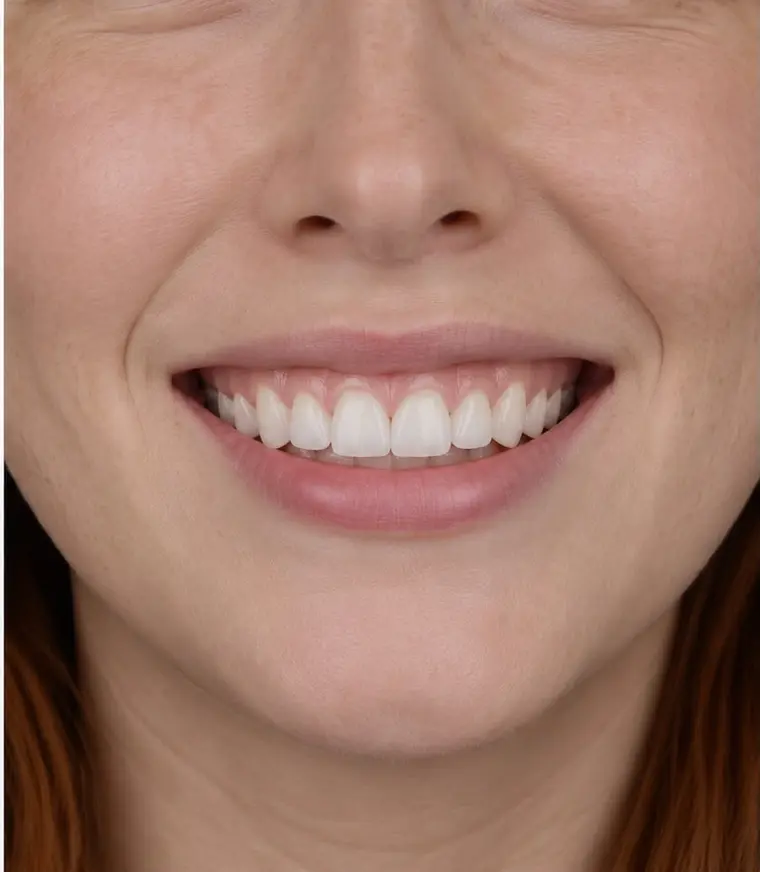
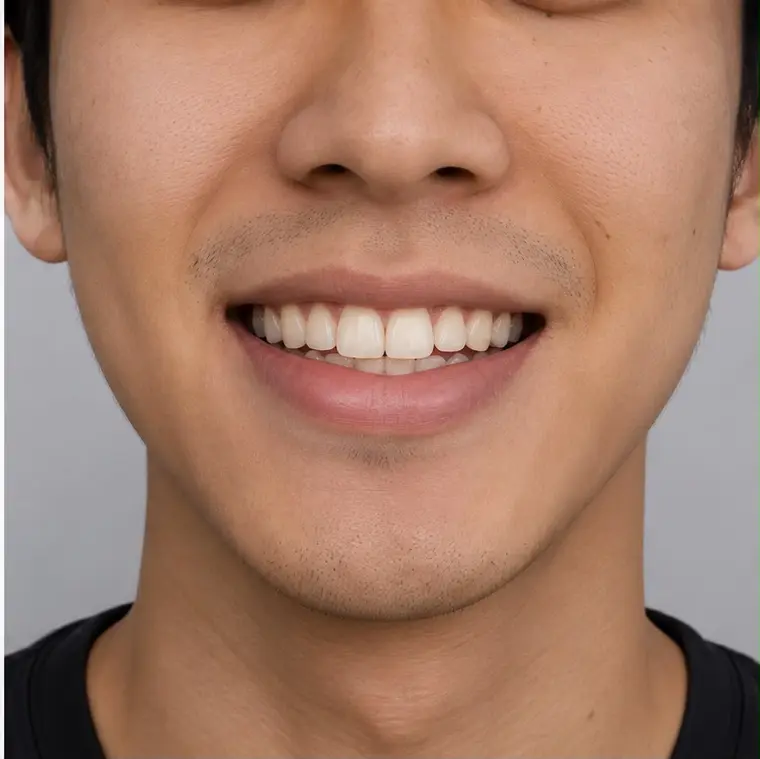
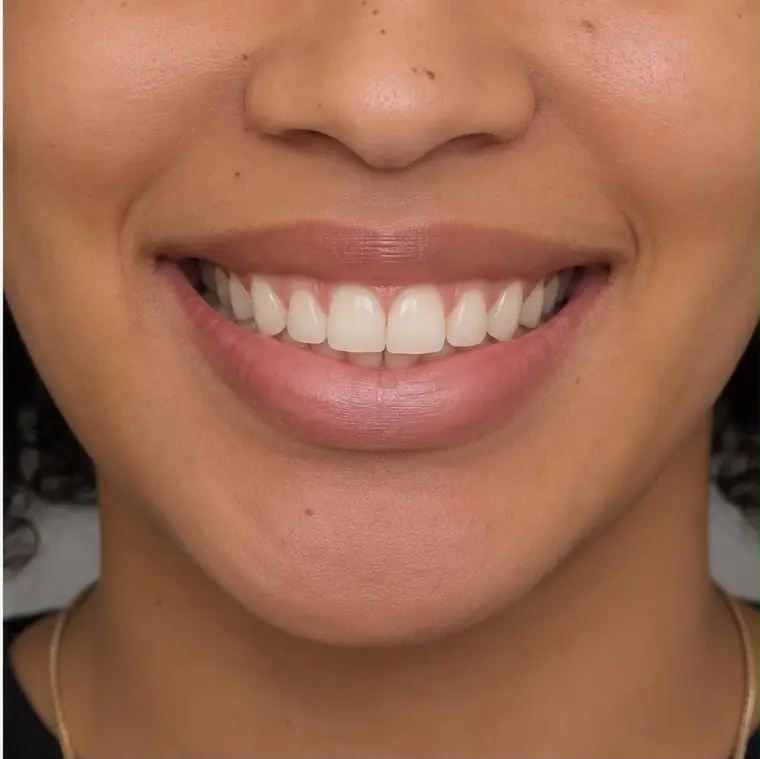
Illustrative smile images. Not patient cases.
Retention: the part people skip
Orthodontic treatment does not end when the appliances come off. The Cochrane review on retention procedures states the position plainly: “Without a phase of retention, there is a tendency for teeth to return to their initial position (relapse). To prevent relapse, almost every person who has orthodontic treatment will require some type of retention” (Littlewood, Millett, Doubleday, Bearn & Worthington, Cochrane Database of Systematic Reviews, January 2016, PMID 26824885).
That review included 15 trials with 1,722 participants and concluded that there is insufficient high-quality evidence to recommend one retention approach over another. Which is itself useful information: if a clinic tells you its particular retainer protocol is proven superior, the evidence does not currently support that claim for anyone.
What this means for you:
- Retainers are indefinite, not a twelve-month formality.
- Fixed retainers — a thin wire bonded behind the front teeth — need checking, and they can debond without you noticing.
- Removable retainers get lost, warped by hot water, and thrown away in hotel bins. Plan for replacements and know who will make them.
- Ask before you start who will make and maintain your retainers once you are home, and get the answer in writing.
Risks worth understanding before you start
- Root resorption.Orthodontic movement causes some shortening of the tooth roots. A systematic review found comprehensive orthodontic treatment increases the incidence and severity of root resorption, that heavy forces may be particularly harmful, and that a two to three month pause in treatment decreases total resorption — concluding in favour of light forces, especially with incisor intrusion (Weltman, Vig, Fields, Shanker & Kaizar, American Journal of Orthodontics and Dentofacial Orthopedics, April 2010, PMID 20362905). In most patients this is minor and of no clinical consequence; it is a reason for careful force control, not for avoiding treatment.
- Decalcification. White marks can develop on enamel around fixed brackets where plaque sits undisturbed. This is a hygiene-dependent risk and is one practical advantage of removable aligners.
- Relapse. See retention, above. It is the most common disappointment in orthodontics and the most preventable.
- Gum recession and sensitivity, particularly where teeth are moved outwards or where gum health was already compromised.
- Discomfort. Teeth are typically tender for a few days after appliances are fitted and after each aligner change. You should feel pressure and tenderness rather than pain.
Aftercare once you are back in the UK or Ireland
What is true:your treatment is planned in Istanbul and your everyday dentist is not. NHS England’s policy, published on 4 November 2024, states that patients who paid for dental treatment privately in the UK or abroad and later need NHS care “are entitled to access NHS dental care for assessment and evaluation to stabilise their condition”, but that “self-funded care that the NHS would not routinely fund would not usually be offered or replaced once stabilisation has been achieved”. The policy also states that “it is expected that patients would initially seek support from their self-funded dental care provider, who should be responsible for any post-treatment clinical issues within a reasonable timeframe”.
There is a further point specific to orthodontics. NHS orthodontic treatment in the UK is generally available to under-18s who meet clinical need criteria, assessed with an established index — it is not routinely provided to adults for appearance. Check current NHS guidance for your own circumstances. For a growing child, the NHS or a local specialist pathway is almost always the better route, and we would tell you so.
What DentVisit provides: a free pre-assessment and case review from your X-ray before you travel, a detailed written treatment plan before any commitment, English-speaking support, and post-treatment remote follow-up.
What you should arrange yourself, before you travel:
- A registered dentist at home for check-ups and hygiene throughout treatment. Orthodontic appliances make cleaning harder, not easier.
- A plan for retainers — who makes replacements, and what it involves if a fixed retainer debonds.
- Which aligner system is being used, in writing, and whether refinement aligners are included.
- Clarity on who to contact and how, outside clinic hours. DentVisit is open Monday to Friday 10:00–18:00 and Saturday 10:00–17:00, Turkish time (UTC+3), and is closed on Sundays.
- Written answers to the questions the General Dental Council advises patients to ask before going abroad, including “Who will be carrying out my treatment and what qualifications do they have?”, “Is the work guaranteed for a certain period of time?”, “What aftercare do you provide?” and “If there are complications and I need further treatment, is this included in the initial cost?”
When to worry during or after orthodontic treatment
Tenderness for a few days after appliances are fitted or trays are changed is expected. The following are not, and should be assessed:
- Pain that increases after the first few days rather than settling.
- A tooth that becomes noticeably loose. Some mobility during active movement is normal; increasing looseness is not.
- Gum swelling, bleeding or recession around specific teeth.
- A bracket, attachment or fixed retainer that comes away, or a wire digging into the cheek — keep any piece you find.
- Aligners that no longer seat fully. This means the teeth are not tracking as planned and needs reviewing, not forcing.
- White or chalky marks appearing on the enamel around brackets — early decalcification, and a signal to change hygiene immediately.
- Any facial swelling with fever, or difficulty swallowing — this is urgent and unrelated to normal orthodontic discomfort. Seek local care the same day.
Frequently asked questions
Can you get braces in Turkey if you live in the UK?
Fixed braces, realistically no. A systematic review of 22 studies put mean fixed appliance treatment at 19.9 months across 17.81 appointments (Tsichlaki et al., 2016), and that schedule cannot be flown. Clear aligners are the workable option for suitable adult cases, because in-person visits are fewer and progress can be reviewed remotely between trips.
How long does orthodontic treatment take?
For fixed appliances, mean duration was 19.9 months (95% CI 19.58–20.22) across 22 studies. Aligner treatment varies widely with the complexity of the case and how consistently trays are worn. Short cosmetic alignment of the front teeth only is quicker than full correction, but it also achieves less — make sure you know which is being proposed.
Are clear aligners as good as braces?
For the right cases, the evidence supports them. A systematic review found aligners a viable alternative for mild to moderate malocclusions in non-growing patients not requiring extraction, but recorded limited efficacy for arch expansion, extraction space closure, occlusal contact corrections and larger discrepancies (Papadimitriou et al., 2018). Outside that description, fixed appliances remain more capable.
Should I get composite bonding instead of aligners?
It depends on what is actually bothering you. Bonding reshapes the visible surface of teeth without moving them, so it can mask mild irregularity in one or two appointments rather than many months. It cannot correct a bite or significant crowding. If appearance is the whole concern, compare both properly on our composite bonding page.
Can I have bonding after my orthodontic treatment?
Yes, and that is the correct sequence. Alignment first, cosmetic finishing afterwards, so that shape and shade are matched to the final tooth positions. Bonding placed before teeth move will no longer fit once they have. Many adults finish alignment and find small edge irregularities remain — that is exactly what bonding is good at.
Do braces or aligners hurt?
Teeth are typically tender for a few days after appliances are fitted and after each aligner change, and you should feel pressure and tenderness rather than sharp pain. Fixed brackets can rub the cheek initially; orthodontic wax helps. Discomfort that increases rather than settles, or a tooth that becomes loose, is not expected and should be reported.
Will I need retainers forever?
Effectively, yes. The Cochrane review states that without retention teeth tend to return towards their original positions and that almost everyone who has orthodontic treatment needs some form of retention (Littlewood et al., 2016). That same review found insufficient evidence to declare any one retainer type superior. Plan for lifelong retention and for replacements.
Can I have orthodontic treatment if I have gum disease?
Not until it is treated and stable. Moving teeth through inflamed tissue with existing bone loss can accelerate that loss. Periodontal assessment and treatment come first, followed by reassessment — see gum disease treatment. This sequencing is not a delaying tactic; it protects the teeth you are paying to reposition.
Is orthodontic treatment available on the NHS?
Generally for under-18s who meet clinical need criteria assessed with an established index, rather than for adult treatment sought on appearance grounds. Waiting lists are commonly long. Check current NHS guidance for your own circumstances. For a child or teenager, a local NHS or specialist pathway is almost always more appropriate than treatment abroad.
Can crowns or veneers straighten my teeth instead?
They can make teeth look straighter, by removing healthy enamel and rebuilding the visible shape. On healthy, unfilled teeth this is a poor trade: enamel does not grow back, and the tooth will need some restoration for the rest of its life. If your teeth are healthy and simply crooked, orthodontics or conservative bonding are the honest options. See cosmetic dentistry.
What happens if my teeth do not move as planned?
This is common enough that it should be in your written plan before you start. Aligner cases frequently need refinement trays; fixed cases need adjustment. Ask specifically whether refinements are included, how many, and what happens if the planned result is not achieved. A plan that does not address this has not been thought through.
Next steps
If your teeth are crowded or your bite does not meet properly, orthodontics is the treatment that actually addresses it — and for most UK and Irish patients, treating near home is the more sensible route. We would rather tell you that than sell you a schedule that cannot be flown.
If what is really bothering you is the appearance of one or two teeth, uneven edges or a small gap, the faster and far more conservative option is composite bonding. If you want to see how the cosmetic options compare with each other, start with cosmetic dentistry. If teeth are missing, alignment usually needs planning alongside dental implants, because the space has to be right before anything is placed in it.
You can send your X-ray by WhatsApp for a free pre-assessment before you book anything: contact DentVisit.
Medical review and sources
This page is general information about treatment options. It is not a diagnosis, and it is not a substitute for a clinical examination and radiographs. Orthodontic suitability cannot be assessed from photographs or from a web page, and individual results vary.
Sources
- Tsichlaki A, Chin SY, Pandis N, Fleming PS. How long does treatment with fixed orthodontic appliances last? A systematic review. American Journal of Orthodontics and Dentofacial Orthopedics. 2016 Mar;149(3):308-18. PMID 26926017. doi:10.1016/j.ajodo.2015.09.020
- Papadimitriou A, Mousoulea S, Gkantidis N, Kloukos D. Clinical effectiveness of Invisalign orthodontic treatment: a systematic review. Progress in Orthodontics. 2018 Sep;19(1):37. PMID 30264270. doi:10.1186/s40510-018-0235-z
- Littlewood SJ, Millett DT, Doubleday B, Bearn DR, Worthington HV. Retention procedures for stabilising tooth position after treatment with orthodontic braces. Cochrane Database of Systematic Reviews. 2016 Jan;2016(1):CD002283. PMID 26824885. doi:10.1002/14651858.CD002283.pub4
- Weltman B, Vig KW, Fields HW, Shanker S, Kaizar EE. Root resorption associated with orthodontic tooth movement: a systematic review. American Journal of Orthodontics and Dentofacial Orthopedics. 2010 Apr;137(4):462-76. PMID 20362905. doi:10.1016/j.ajodo.2009.06.021
- Demarco FF, Collares K, Coelho-de-Souza FH, Correa MB, Cenci MS, Moraes RR, Opdam NJ. Anterior composite restorations: A systematic review on long-term survival and reasons for failure. Dental Materials. 2015 Oct;31(10):1214-24. PMID 26303655. doi:10.1016/j.dental.2015.07.005
- General Dental Council. Going abroad for dental treatment — patient information. gdc-uk.org
- NHS England. Avoidance of doubt: Clinical policy for self-funded dental treatment requiring NHS intervention. Published 4 November 2024. england.nhs.uk
- NHS. Treatment abroad checklist. nhs.uk
Sources reviewed August 2026. PubMed records (title, authors, journal, year, numeric results) verified against the NCBI E-utilities API on 8 August 2026.
Book Appointment
Make an appointment to get detailed information about orthodontic treatment and create a personalized treatment plan.
Book NowImportant Note: The information on this website is for general informational purposes only and does not replace professional medical advice. Please consult a qualified dentist for any health concern or treatment decision.