
Root Canal Treatment in Istanbul: An Honest Guide for UK and Irish Patients
Root canal treatment — endodontics — is the procedure that saves a tooth whose inner pulp has become infected or irreversibly damaged. Instead of removing the tooth, the pulp is removed, the canals inside the root are cleaned, shaped and sealed, and the tooth is rebuilt on top.
If you live in the UK or Ireland and are weighing up having this done in Istanbul, root canal treatment is genuinely one of the better-suited treatments for a short trip. It is also the one where the step people forget — the crown that goes on afterwards — decides whether the work lasts. This page covers both, along with who should not travel for it at all.
Is it worth travelling to Turkey for root canal treatment?
Direct answer
Root canal treatment removes infected or damaged pulp from inside a tooth, disinfects and seals the canals, so the natural tooth can be kept rather than extracted. It is one of the few treatments that can realistically be completed in a short trip, across two to four working days, provided the final crown is fitted before you fly home.
What root canal treatment actually involves
The procedure is more methodical than dramatic. In sequence:
- Diagnosis. Examination, radiographs and sensitivity testing establish whether the pulp is inflamed, infected or dead, and whether the tooth is restorable at all.
- Local anaesthetic. The tooth and surrounding tissue are numbed. You should feel pressure and vibration rather than pain.
- Isolation. The tooth is isolated, normally with a rubber dam — a sheet that keeps saliva and bacteria out of the canals and stops small instruments being swallowed.
- Access and removal. A small opening is made through the crown of the tooth and the pulp tissue is removed.
- Cleaning and shaping. The canals are cleaned mechanically and disinfected with irrigating solutions. This is the part that determines the outcome, and it is unhurried by necessity.
- Sealing. The canals are filled with a root filling material and sealed so bacteria cannot recolonise them.
- Rebuilding the tooth. A core is built inside the tooth, and in most back teeth a crown is placed over it.
Treatment may be completed in a single appointment or spread across two, depending on the tooth, the number of canals and whether there is active infection. Both approaches are in routine clinical use.
The step most patients underestimate: the crown
A root-treated tooth has been hollowed out and has lost its blood supply. It is more brittle than a living tooth, and back teeth in particular take heavy loads.
The scale of this matters. In an epidemiological study of 1,462,936 teeth in 1,126,288 patients across 50 US states, followed for 8 years, 97% of teeth were retained after initial non-surgical root canal treatment. Of the teeth that were extracted, 85% had no full coronal coverage — no crown (Salehrabi & Rotstein, Journal of Endodontics, December 2004, PMID 15564861).
That single figure should shape your travel plan. A root canal completed abroad without the crown fitted is an unfinished treatment, and finishing it at home means paying twice.
- 01
Anaesthetic and isolation
The tooth is numbed and isolated with a rubber dam so nothing from saliva can enter the canal.
- 02
Access and cleaning
The pulp chamber is opened and the canals are cleaned along their full working length — measured, not estimated.
- 03
Shaping and disinfection
Canals are shaped and irrigated. Some teeth are treated over two visits with a dressing in between.
- 04
Sealing
The canals are filled and sealed so bacteria cannot re-enter from the tip of the root.
- 05Often a crown
Restoring the tooth
A back tooth usually needs cuspal coverage afterwards. Ask whether that is in the quote you were given.
What the evidence says about success rates
Two different words get used interchangeably in marketing, and they do not mean the same thing.
- Success means the infection around the root tip has healed, judged strictly on radiographs. In a systematic review of primary root canal treatment, weighted pooled success rates ranged between 68% and 85% when strict criteria were applied to treatments reviewed at least a year afterwards (Ng, Mann, Rahbaran, Lewsey & Gulabivala, International Endodontic Journal, December 2007, PMID 17931389).
- Survival means the tooth is still in your mouth and functioning. In a prospective study, 4-year cumulative tooth survival was 95.4% after primary root canal treatment and 95.3% after retreatment (Ng, Mann & Gulabivala, International Endodontic Journal, July 2011, PMID 21366627).
So: teeth survive at high rates, while strict radiographic healing is less certain than advertising suggests. If a clinic quotes you a single “98% success rate” with no follow-up period and no source, it is describing survival at best and marketing at worst.
Who is a good candidate
Root canal treatment tends to go well when:
- The tooth is restorable — enough sound structure remains above the gum to hold a crown.
- Your gums around that tooth are healthy, or gum disease has been treated first.
- The problem is confined to the pulp rather than a vertical fracture through the root.
- You can stay long enough for the root filling and the permanent restoration.
- You are not in acute pain right now — see the next section.
Who is NOT a good candidate
This section is here because a clinic that says yes to every tooth is telling you something about itself.
You should not be travelling for this if:
- You are in acute pain or have facial swelling today. This is the most important line on the page. Severe toothache with swelling, fever or difficulty swallowing needs same-day local care, not a flight in three weeks. Seek emergency dental care where you are.
- The tooth is not restorable. A tooth broken well below the gum line, or with a vertical root fracture, cannot be reliably saved. Root-treating it produces a tooth that fails later and costs more than extraction would have.
- You have active, untreated gum disease. The tooth may be lost to the gum condition even if the root canal succeeds. Treat the foundation first — see our guide to gum disease treatment.
- You cannot stay for the crown, and have no plan or budget to have one fitted at home promptly.
You should think much harder if:
- You are being offered root canal treatment on several teeth at once as part of a cosmetic package. Root canal work carried out to make room for crowns on otherwise healthy teeth is the single most criticised practice in dental tourism.
- You have been quoted before anyone has seen a radiograph of that tooth.
- The plan does not say, in writing, which tooth, how many canals and what final restoration is included.
Root canal and crown vs extraction and implant vs extraction and bridge
There is no universally right answer. There is a right answer for that specific tooth.
| Criterion | Root canal treatment + crown | Extraction + implant | Extraction + bridge |
|---|---|---|---|
| Keeps your natural tooth | Yes | No | No |
| Surgery involved | No | Yes | No |
| Typical appointments | 2–4 | 5–8 across two trips | 3–4 |
| Trips to Istanbul | Usually 1 | Usually 2 | Usually 1 |
| Time to complete | Days | 3–6 months, longer with grafting | 1–2 weeks |
| Neighbouring teeth affected | No | No | Yes — adjacent teeth are prepared and crowned |
| Published evidence | 97% of teeth retained at 8 years across 1,462,936 teeth (Salehrabi & Rotstein, J Endod, December 2004); 4-year survival 95.4% (Ng et al., Int Endod J, July 2011) | 10-year implant survival 96.4% by traditional analysis, 93.2% in a sensitivity meta-analysis accounting for follow-up losses (Howe, Keys & Richards, J Dent, May 2019) | No figure quoted — depends on the health of the anchor teeth |
| Main risk to manage | Persistent or recurrent infection; fracture if left without a crown | Peri-implantitis; needs lifelong hygiene and maintenance | Failure of an anchor tooth takes the whole bridge with it |
| If it fails | Can often be retreated, or treated surgically | Replacement implant, usually after healing and sometimes grafting | Bridge remade, or converted to an implant |
| Relative cost (ranking, not a price) | Lowest of the three | Highest | Middle |
| Best for | A restorable tooth with healthy surrounding bone | A tooth that cannot be saved, with good bone and healthy gums | A tooth that cannot be saved where neighbouring teeth already need crowns |
Comparison compiled by DentVisit, August 2026. Survival figures describe study populations in the cited peer-reviewed sources, not individual outcomes.
Where we will argue against ourselves: root canal treatment is not always the better option, and pretending otherwise would be dishonest. A heavily broken-down molar with little sound tooth left, or one with a cracked root, is often better extracted than root-treated. Some back teeth — particularly a lone second molar — can reasonably be extracted and simply not replaced, and that is a legitimate clinical plan rather than a failure. If your tooth is genuinely not savable, see our guide to dental implants instead of paying for treatment that buys you two years.
Keep the tooth
Root canal
Your own root stays in the jaw. Usually the least invasive route whenever the tooth is still restorable.
Extract, leave the gap
Cheapest today
Neighbouring teeth drift and the opposing tooth over-erupts. The bill usually arrives later, in a different form.
Extract and implant
Months, two trips
A new root and a new crown. More surgery, more time and usually more money than saving the tooth would have been.
Why root canal quotes vary so widely
If three quotes look nothing alike, the difference is usually structural rather than a matter of one clinic being greedy:
- Different teeth. A front tooth typically has one canal; a molar commonly has three or four. The work is not comparable.
- Whether the crown is included.This is the single biggest source of confusion. A “root canal” price that stops at the root filling excludes the part that keeps the tooth alive long-term.
- Whether it is a first treatment or a retreatment. Removing an existing root filling before redoing it adds significant time.
- Whether a core build-up or post is needed to give the crown something to hold on to.
- Whether review radiographs are included.
Before comparing any two prices, make them comparable: ask for the tooth number, the number of canals, and whether the final crown is in the figure.
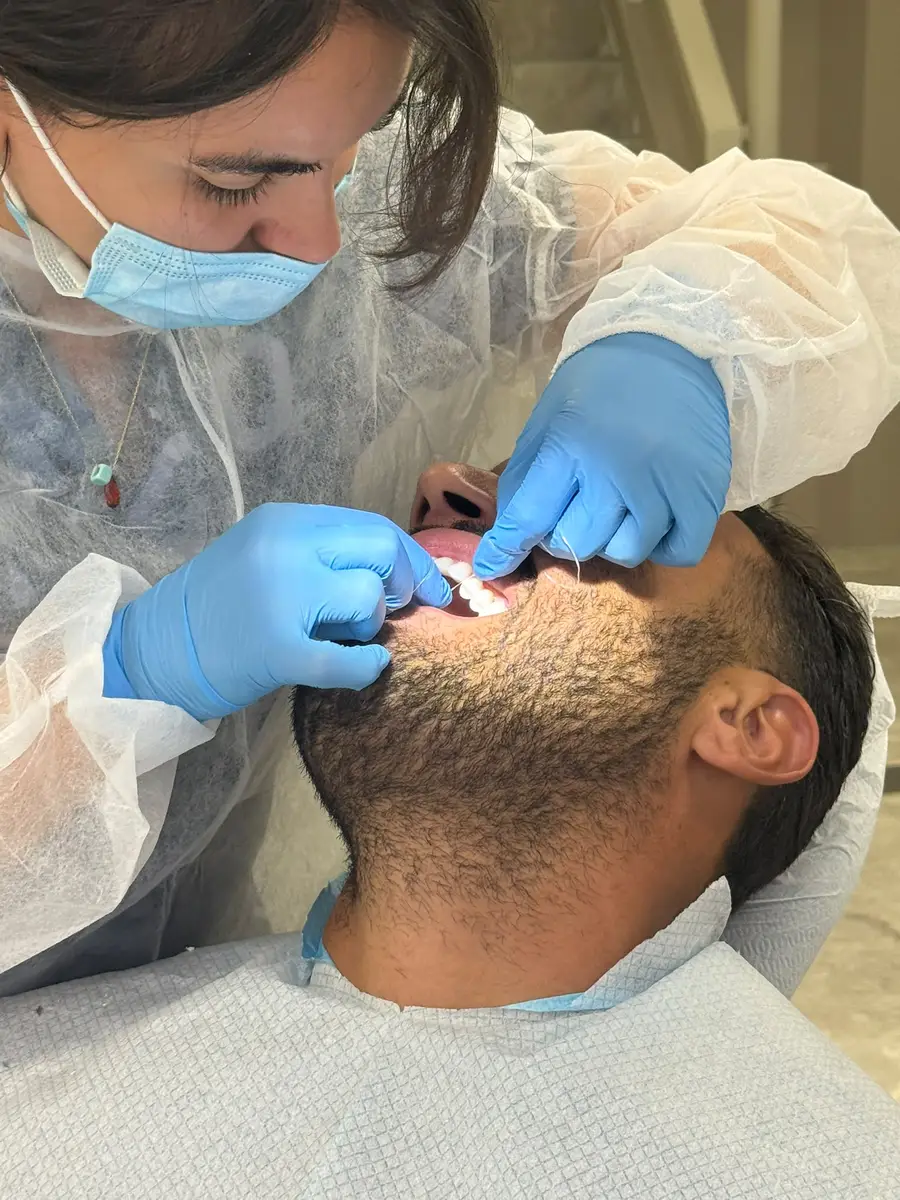
A realistic trip to Istanbul
The sequence below is the clinical pathway, not a holiday itinerary. Your own schedule is confirmed after your case is reviewed, and single-canal front teeth are shorter.
Root canal treatment with a crown — typically 3–5 working days
| Day | What happens |
|---|---|
| Day 1 | Examination, radiographs, intraoral scan, diagnosis and written treatment plan. Treatment often started the same day: local anaesthetic, access, cleaning and shaping of the canals, temporary seal. |
| Day 2 | Canals sealed and root filling completed where a second visit is used. Confirmatory radiograph. Core build-up placed. |
| Day 3 | Tooth prepared for the crown, digital scan or impression, shade selected, temporary crown fitted. |
| Day 4 | Laboratory fabrication. No chair time. |
| Day 5 | Final crown fitted, bite checked and adjusted, polishing, aftercare briefing. |
Root canal treatment where a filling rather than a crown is planned — typically 2–3 working days
| Day | What happens |
|---|---|
| Day 1 | Examination, radiographs, diagnosis, written plan. Canals cleaned and shaped. |
| Day 2 | Root filling completed, confirmatory radiograph, permanent restoration placed. |
| Day 3 | Review, bite check, aftercare briefing. |
Sequence published by DentVisit, August 2026. Timings are typical clinical ranges and are confirmed individually after case review.
Three practical rules for booking flights:
- Do not book a flight to treat an emergency. If you have swelling, fever or pain that is keeping you awake, get seen locally today. Travel is for planned treatment.
- Leave at least one clear working day between the crown being fitted and your flight home. A new crown often needs a small bite adjustment once you have eaten with it — minutes in Istanbul, another trip from Manchester.
- Ask before you book whether the crown is included in your plan and in your dates. If it is not, you are booking half a treatment.
Before you travel, you can send your X-ray to DentVisit by WhatsApp for a free pre-assessment and case review, and a detailed written treatment plan is provided before any commitment — so you know which teeth are proposed for treatment, and how many days it takes, before you book anything.
Two questions worth asking any clinic, here or at home
These are not gotcha questions. They are the two details that most affect the outcome and are almost never volunteered:
- “Will a rubber dam be used?” Isolating the tooth from saliva during treatment is standard practice in modern endodontics, and it is a reasonable thing to confirm before you sit down.
- “Is the final crown included, and will it be fitted before I fly?” Get the answer in writing, on the treatment plan, alongside the tooth number.
What happens when you fly home
This is the objection UK dental websites press hardest, and it deserves a straight answer rather than silence.
What is true:the clinician who treated the tooth is in Istanbul and your everyday dentist is not. NHS England’s policy, published on 4 November 2024, states that patients who paid for dental treatment privately in the UK or abroad and later need NHS care “are entitled to access NHS dental care for assessment and evaluation to stabilise their condition”, but that “self-funded care that the NHS would not routinely fund would not usually be offered or replaced once stabilisation has been achieved”. The policy also states that “it is expected that patients would initially seek support from their self-funded dental care provider, who should be responsible for any post-treatment clinical issues within a reasonable timeframe”.
In plain terms: if that tooth flares up, the NHS will make you safe and comfortable. It will not routinely redo self-funded root canal work. Your first call is to the clinic that carried out the treatment.
One aftercare detail specific to root canals: healing around the root tip is assessed on a radiograph, not by how the tooth feels. A review radiograph is normally recommended around a year after treatment. That review will happen at home, which is a practical reason to register with a dentist in the UK or Ireland before you travel.
What DentVisit provides: a free pre-assessment and case review from your X-ray before you travel, a detailed written treatment plan before any commitment, English-speaking support, and post-treatment remote follow-up.
What you should arrange yourself, before you travel:
- A registered dentist at home for routine check-ups and the one-year review radiograph.
- Copies of your treatment plan and your radiographs. Any dentist assessing that tooth later will want to see the pre-operative and post-operative films.
- Clarity on who to contact and how, outside clinic hours. DentVisit is open Monday to Friday 10:00–18:00 and Saturday 10:00–17:00, Turkish time (UTC+3), and is closed on Sundays.
- Written answers to the questions the General Dental Council advises patients to ask before going abroad, including “Who will be carrying out my treatment and what qualifications do they have?”, “Is the work guaranteed for a certain period of time?”, “What aftercare do you provide?” and “If there are complications and I need further treatment, is this included in the initial cost?”
When to worry after root canal treatment
Some tenderness for a few days, particularly on biting, is expected while the ligament around the root settles. The following are not, and should be assessed:
- Pain that increases after the first few days instead of settling.
- Swelling of the face or gum, especially with fever or a bad taste — this suggests spreading infection.
- Any difficulty swallowing or breathing, or swelling closing the eye — this is an emergency. Seek urgent local care the same day; do not wait for your next trip.
- A bite that feels high on the treated tooth. Common after a new crown, quick to adjust, and damaging if left.
- A temporary filling or temporary crown that comes out. The canals must not be left open to saliva — arrange to be seen promptly.
- A piece of the tooth or crown breaking away, or the tooth feeling loose.
- A small spot or pimple on the gum that discharges — this can indicate persistent infection even without pain.
Frequently asked questions
Does root canal treatment hurt?
Root canal treatment usually relieves pain rather than causing it. In a systematic review of 72 studies, mean pain prevalence was 81% before treatment, 40% at 24 hours and 11% at seven days, with mean severity falling from 54 to 24 to 5 on a 100-point scale (Pak & White, J Endod, April 2011). Treatment is carried out under local anaesthetic; you should feel pressure rather than pain.
How many days do I need in Istanbul for root canal treatment?
Typically three to five working days if a crown is being fitted, or two to three if the tooth is being restored with a filling. Front teeth with a single canal are usually quicker than molars with three or four. Always leave one clear day between the crown being fitted and your flight home.
What is the success rate of root canal treatment?
It depends which word is being used. Strict radiographic success ranged between 68% and 85% in a systematic review of primary treatment (Ng et al., 2007). Tooth survival — the tooth still being in the mouth — was 97% at eight years across 1,462,936 teeth (Salehrabi & Rotstein, 2004). Single unsourced figures above these should be treated as advertising.
Do I definitely need a crown afterwards?
Not always, but usually for back teeth, which take heavy chewing loads. The evidence is pointed: among teeth extracted after root canal treatment in the 2004 US study of over 1.4 million teeth, 85% had no full coronal coverage. Front teeth with minimal tooth loss are sometimes restored with a filling instead. Your clinician should specify which, in writing.
Is it better to have a root canal or an implant?
Where the tooth is restorable, keeping it is generally the more conservative option: no surgery, no healing period, one trip instead of two. An implant becomes the better plan when the tooth is fractured, broken down below the gum or surrounded by bone loss. This is a decision made from a radiograph and an examination, not from a price list.
Can root canal treatment be done in one visit?
Often, yes. Single-visit and multiple-visit treatment are both in routine use, and the choice depends on the tooth, the number of canals and whether there is active infection with discharge. Compressing a complex molar into one short appointment to fit a flight is the wrong reason to choose it. Ask which is planned for your tooth and why.
Can I fly after root canal treatment?
Generally yes, once the tooth is sealed and any temporary restoration is secure. Flying with an unsealed or acutely infected tooth is uncomfortable and makes complications harder to manage. The bigger issue is not the flight but the sequence: fly home after the crown is fitted and checked, not between the root filling and the crown.
What if my tooth still hurts after I get home?
Mild tenderness on biting can persist for a couple of weeks. Pain that increases, or swelling, needs assessment — contact the treating clinic first, as NHS England's policy states patients are expected to seek support from their self-funded provider initially. An NHS dentist can assess and stabilise you. Keep your treatment plan and radiographs so any dentist can act quickly.
Is root canal treatment available on the NHS?
Yes. Unlike purely cosmetic work, root canal treatment addresses infection and pain, so it is provided on the basis of clinical need under NHS band charges. The practical barriers most patients describe are access and waiting times rather than eligibility. Check current NHS guidance for your own circumstances, as availability varies by practice.
Will my tooth go dark after root canal treatment?
A root-treated front tooth can darken over time because it no longer has a blood supply. This is manageable: internal whitening, composite bonding over the front surface, or a crown or veneer, depending on how much tooth structure remains. Raise it at the planning stage if the tooth is in your smile line, so shade is dealt with once.
Can a failed root canal be retreated?
Usually, yes. The existing root filling is removed, the canals are re-cleaned and re-sealed. In a prospective study, 4-year tooth survival after retreatment was 95.3%, essentially the same as after primary treatment (Ng, Mann & Gulabivala, 2011). Where retreatment is not possible, a small surgical procedure at the root tip, or extraction, are the remaining options.
Next steps
If you have a tooth that is painful, tender to bite on, or has been flagged as needing root canal treatment, the starting point is a radiograph and a written plan naming the tooth — not a price.
If the tooth turns out not to be savable, see our guide to dental implants. If the tooth is fine but you dislike its colour or shape, the more conservative route is composite bonding or, more broadly, cosmetic dentistry.
You can send your X-ray by WhatsApp for a free pre-assessment before you book anything: contact DentVisit.
Medical review and sources
This page is general information about treatment options. It is not a diagnosis, and it is not a substitute for a clinical examination and radiographs. Individual results vary and cannot be predicted from a web page. If you have facial swelling, fever or difficulty swallowing, seek urgent local dental or medical care today.
Sources
- Salehrabi R, Rotstein I. Endodontic treatment outcomes in a large patient population in the USA: an epidemiological study. Journal of Endodontics. 2004 Dec;30(12):846-50. PMID 15564861. doi:10.1097/01.don.0000145031.04236.ca
- Ng YL, Mann V, Rahbaran S, Lewsey J, Gulabivala K. Outcome of primary root canal treatment: systematic review of the literature — part 1. Effects of study characteristics on probability of success. International Endodontic Journal. 2007 Dec;40(12):921-39. PMID 17931389. doi:10.1111/j.1365-2591.2007.01322.x
- Ng YL, Mann V, Gulabivala K. A prospective study of the factors affecting outcomes of non-surgical root canal treatment: part 2: tooth survival. International Endodontic Journal. 2011 Jul;44(7):610-25. PMID 21366627. doi:10.1111/j.1365-2591.2011.01873.x
- Pak JG, White SN. Pain prevalence and severity before, during, and after root canal treatment: a systematic review. Journal of Endodontics. 2011 Apr;37(4):429-38. PMID 21419285. doi:10.1016/j.joen.2010.12.016
- Howe MS, Keys W, Richards D. Long-term (10-year) dental implant survival: A systematic review and sensitivity meta-analysis. Journal of Dentistry. 2019 May;84:9-21. PMID 30904559. doi:10.1016/j.jdent.2019.03.008
- General Dental Council. Going abroad for dental treatment — patient information. gdc-uk.org
- NHS England. Avoidance of doubt: Clinical policy for self-funded dental treatment requiring NHS intervention. Published 4 November 2024. england.nhs.uk
- NHS. Treatment abroad checklist. nhs.uk
Sources reviewed August 2026. PubMed records (title, authors, journal, year, numeric results) verified against the NCBI E-utilities API on 8 August 2026.
Book Appointment
Make an appointment to get detailed information about root canal treatment and create a personalized treatment plan.
Book NowImportant Note: The information on this website is for general informational purposes only and does not replace professional medical advice. Please consult a qualified dentist for any health concern or treatment decision.