
Oral and Maxillofacial Surgery in Istanbul: An Honest Guide for UK and Irish Patients
Oral and maxillofacial surgery is the surgical side of dentistry: removing teeth that cannot be removed simply, taking out impacted wisdom teeth, removing cysts, taking biopsies, and preparing the mouth for implants or dentures.
It is also the area where dental travel goes wrong most visibly, for one reason. Surgery has a recovery period, and a recovery period does not fit neatly around a return flight. This page is written to help you judge whether the surgery you are being offered is necessary at all, and if it is, how to plan the trip so that the healing happens in the right place.
Can you travel to Turkey for oral surgery?
Direct answer
Oral and maxillofacial surgery covers extractions, wisdom tooth removal, cysts, biopsies and surgery to prepare the mouth for implants or dentures. Straightforward surgical extractions suit a short trip, provided you allow several days before flying. Major jaw surgery does not, because it needs hospital care, orthodontics and months of follow-up.
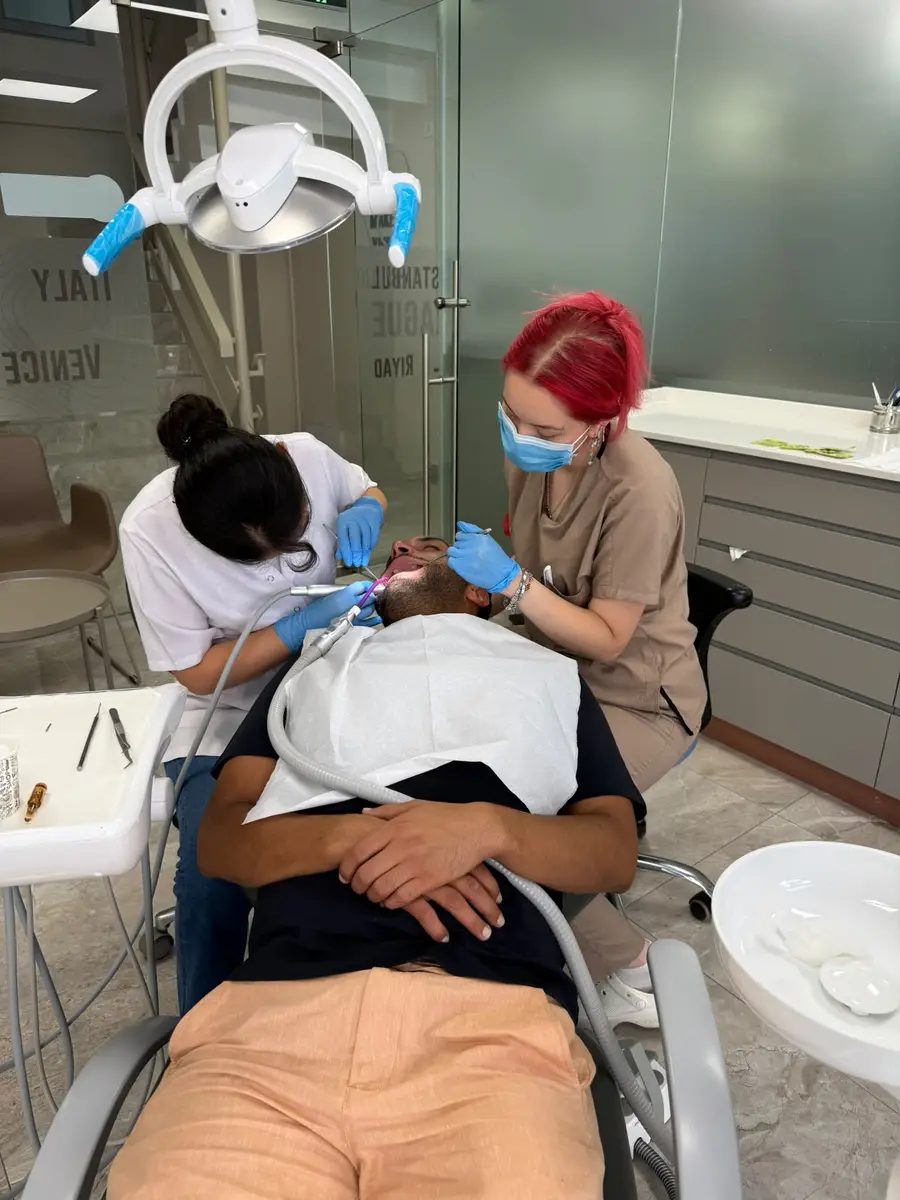
What this speciality actually covers
- Surgical extraction of teeth that are broken down, root-filled and fractured, or too fragile to remove whole.
- Impacted wisdom teeth — teeth that have not erupted into a functional position.
- Removal of cysts and other lesions of the jaws, and biopsy of tissue that needs a diagnosis.
- Pre-prosthetic surgery — reshaping bone or soft tissue so that a denture or restoration fits.
- Bone grafting and sinus procedures carried out as part of implant treatment; see dental implants.
- Apical surgery — a small procedure at the root tip where root canal retreatment is not possible; see root canal treatment.
What it also covers, but which does not belong in a travel plan: orthognathic surgery, the corrective repositioning of the jaws. That treatment is hospital-based, is normally combined with a long course of orthodontics before and after, and involves months of monitored recovery. It is a legitimate and often life-changing treatment. It is not a treatment anyone should attempt to compress into a trip abroad, and this page will not pretend otherwise.
01Vertical
Upright. Often erupts normally.
02Mesial
Tips forward into the tooth in front. The most common pattern.
03Horizontal
Lying on its side under the gum.
04Distal
Tips backwards, away from the tooth in front.
The most important section: do those wisdom teeth need removing?
More UK and Irish patients are talked into wisdom tooth removal abroad than into almost any other procedure, often bundled into a package. The published position in the UK is the opposite of that practice.
NICE guidance is explicit. In Guidance on the extraction of wisdom teeth (technology appraisal TA1, published 27 March 2000), the National Institute for Health and Care Excellence recommends that the practice of prophylactic removal of pathology-free impacted third molars should be discontinued in the NHS, and that surgical removal of impacted third molars should be limited to patients with evidence of pathology. The guidance sets out what counts as pathology, including unrestorable caries, non-treatable pulpal or periapical pathology, cellulitis, abscess and osteomyelitis, internal or external resorption of the tooth or adjacent teeth, fracture of the tooth, disease of the follicle including cyst or tumour, and teeth impeding surgery or reconstructive jaw surgery.
The evidence base is thin in both directions.A Cochrane review of surgical removal versus retention for asymptomatic, disease-free impacted wisdom teeth found only two eligible studies and concluded that “insufficient evidence is available to determine whether asymptomatic disease-free impacted wisdom teeth should be removed or retained”, noting that retention may carry an increased long-term risk of periodontitis affecting the adjacent molar, on very low-certainty evidence, and recommending regular clinical monitoring where teeth are retained (Ghaeminia, Nienhuijs, Toedtling, Perry, Tummers, Hoppenreijs, Van der Sanden & Mettes, Cochrane Database of Systematic Reviews, 4 May 2020, PMID 32368796).
Put plainly: if your wisdom teeth are causing symptoms or show disease, removal is a real clinical decision. If they are quiet and healthy, the honest answer is that nobody can currently prove removal helps you — and every removal carries risk.
The risks, with numbers
You are entitled to these figures before you agree to anything.
Nerve injury. In a systematic review of 23 studies covering 26,427 patients and 44,171 teeth, 1.20% developed a transient inferior alveolar nerve deficit and 0.28% a permanent deficit following removal of mandibular third molars. Depth of impaction, proximity to the mandibular canal, the surgical approach, intra-operative exposure of the nerve and the surgeon’s level of experience were all significant factors (Kang, Sah & Fei, Journal of Stomatology, Oral and Maxillofacial Surgery, February 2020, PMID 31476533).
A nerve deficit means numbness or altered sensation of the lip, chin or tongue on that side. Temporary is uncomfortable and resolves. Permanent does not.
Where 3D imaging genuinely earns its place. European Commission guidelines state that where conventional radiographs suggest a direct inter-relationship between a mandibular third molar and the mandibular canal, and a decision to perform surgical removal has been made, CBCT may be indicated (SEDENTEXCT Guideline Development Panel, Radiation Protection No. 172, European Commission, 2012, recommendation 4.35). Note the order: the conventional radiograph comes first, and the scan answers a specific question. Routine scanning of every arriving patient is a different thing entirely — see digital dentistry.
Antibiotics.A Cochrane review of 23 trials with 3,206 participants found that, in healthy people having third molars removed, prophylactic antibiotics reduced the risk of infection (RR 0.34, 95% CI 0.19–0.64; 1,728 participants) with a number needed to treat of 19, and reduced dry socket (RR 0.66, 95% CI 0.45–0.97; 1,882 participants) with a number needed to treat of 46 — both on low-certainty evidence — and concluded that clinicians should evaluate if and when to prescribe prophylactic antibiotics for each individual patient (Lodi, Azzi, Varoni, Pentenero, Del Fabbro, Carrassi, Sardella & Manfredi, Cochrane Database of Systematic Reviews, 24 February 2021, PMID 33624847).
Antibiotics are therefore neither automatic nor forbidden. If you are handed a course without a reason, ask what the reason is.
Other recognised risks, described by NICE in the same guidance, include alveolar osteitis (dry socket), infection, haemorrhage, and temporary local swelling, pain and restricted mouth opening.
Who is a good candidate
Surgery abroad tends to go smoothly when:
- There is a documented clinical reason for the procedure, visible on a radiograph.
- The extraction is planned rather than urgent.
- You are medically well, or any condition is controlled and disclosed in advance.
- You can stay long enough for the initial healing and, where used, suture removal.
- You have a dentist at home who knows you are having it done.
Who is NOT a good candidate
You should not be travelling for oral surgery if:
- You have facial swelling, fever or difficulty swallowing today. This is the most important line on the page. Spreading dental infection can be serious and needs same-day local care, not a flight in three weeks.
- You are being offered removal of healthy, symptom-free wisdom teeth, particularly as part of a package with other treatment. See the NICE position above.
- You must fly home the next day. Bleeding and swelling do not respect itineraries; swelling typically peaks after the first 48 to 72 hours, which is the point at which most short-trip patients are already home.
- You are seeking corrective jaw surgery. It requires hospital care, coordinated orthodontics and months of follow-up.
You must disclose, and may need your plan changed, if:
- You take an anticoagulant or antiplatelet medicine — including warfarin, a direct oral anticoagulant, clopidogrel or aspirin prescribed by a doctor. Do not stop taking it on your own. UK dental practice for these patients is set out in Management of Dental Patients Taking Anticoagulants or Antiplatelet Drugs (Scottish Dental Clinical Effectiveness Programme, 2nd edition, March 2022), which covers bleeding-risk assessment and treatment planning. Any clinic operating on you needs to know, in advance, exactly what you take and why.
- You take, or have taken, a bisphosphonate or denosumab, or have had other anti-resorptive or anti-angiogenic treatment, commonly prescribed for osteoporosis or as part of cancer care. These medicines are associated with medication-related osteonecrosis of the jaw, and extraction planning changes accordingly; see Oral Health Management of Patients at Risk of Medication-related Osteonecrosis of the Jaw (Scottish Dental Clinical Effectiveness Programme, March 2017, reviewed and extant March 2024).
- You have had radiotherapy to the head or neck, are immunosuppressed, or have poorly controlled diabetes.
- You have active gum disease. Healing is worse and the surrounding teeth may be next; see gum disease treatment.
Monitoring
No surgery today
A symptom-free, healthy wisdom tooth can be reviewed rather than removed. Doing nothing is a decision, and it needs recording as one.
Coronectomy
Roots left in place
Only the crown is removed, leaving roots that sit against the nerve. Trades one risk for another, and the retained roots need follow-up.
Full removal
Tooth out
The whole tooth is taken out. The usual answer where the tooth is causing repeated problems and the nerve is not unusually close.
Removal versus coronectomy versus monitoring
For a lower wisdom tooth lying close to the nerve, there is more than one legitimate plan.
| Criterion | Full surgical removal | Coronectomy (crown removed, roots left) | Retention with monitoring |
|---|---|---|---|
| What happens | The whole tooth is removed | The crown is removed and the roots are deliberately left in place | Nothing is removed; the tooth is reviewed clinically and radiographically |
| When it is used | Documented pathology, tooth not intimate with the nerve | Roots intimate with the mandibular canal, where full removal carries higher nerve risk | Asymptomatic, disease-free teeth |
| Nerve risk | Transient inferior alveolar deficit 1.20%, permanent 0.28% across 44,171 teeth (Kang et al., J Stomatol Oral Maxillofac Surg, February 2020) | Designed specifically to reduce this risk | None from surgery |
| Recovery | Several days of swelling and restricted opening | Similar early recovery | None |
| Later problems | Dry socket, infection, bleeding | Retained roots can migrate and occasionally need a second procedure | Cochrane found very low-certainty evidence of increased long-term periodontitis risk at the adjacent molar |
| Evidence position | Justified where pathology is present (NICE TA1, 27 March 2000) | An accepted alternative in high-risk anatomy | “Insufficient evidence… whether asymptomatic disease-free impacted wisdom teeth should be removed or retained” (Ghaeminia et al., Cochrane, 4 May 2020) |
| Suits a short trip | Yes, with adequate recovery days | Yes, with adequate recovery days | Not applicable |
| Relative cost (ranking, not a price) | Middle | Highest | Lowest |
Comparison compiled by DentVisit, August 2026. Figures describe study populations in the cited peer-reviewed sources, not individual outcomes. Which option applies to you is a clinical decision made from radiographs and examination.
Where we will argue against ourselves: the single most useful thing this page can do is talk some readers out of surgery. If your wisdom teeth are asymptomatic and disease-free, the best-supported plan is to leave them alone and have them monitored — a plan that earns this clinic nothing. Equally, a simple extraction that your own dentist can do next week should be done next week, at home, near your own bed, not carried across a border. Travel makes sense for surgery when the procedure is genuinely complex, genuinely indicated, and part of a larger plan you are already coming for. Outside that, it is an expensive way to acquire a swollen face in an unfamiliar city.
Why surgical quotes vary so widely
- “Extraction” covers very different operations. A loose tooth lifted out in two minutes and a deeply impacted lower wisdom tooth requiring bone removal are not the same procedure and should not carry the same price.
- Per tooth or per quadrant. Two lower wisdom teeth on the same side may be quoted differently from one on each side, because of how the appointment is staged.
- Whether radiographs are included, and whether any additional imaging is quoted separately.
- Whether review and suture removal are included — and whether the review falls inside your travel dates.
- Whether medication is included.
Before comparing prices, ask which teeth, whether the removal is surgical, and whether review and suture removal are inside your dates.
- 01Day 0
Day of surgery
Carried out under local anaesthetic. Bleeding is controlled before you leave, and someone should be with you afterwards.
- 02Days 1–3
Swelling peaks
Swelling and jaw stiffness are usually at their worst. Cold packs, soft food and the painkillers you were given.
- 03Days 4–7
Settling
Symptoms ease. Pain that increases instead of settling is a reason to contact the clinic, not a reason to wait.
- 04About a week
Review
Sutures and healing checked. Arrange this before you fly — with the clinic that treated you or a dentist at home.
A realistic trip to Istanbul
The sequence below is the clinical pathway, not a holiday itinerary. Your own schedule is confirmed after your case is reviewed.
Surgical removal of impacted wisdom teeth — typically 5–7 days in the city
| Day | What happens |
|---|---|
| Day 1 | Examination, radiographs, assessment of the relationship between the roots and the nerve, written treatment plan and consent discussion. |
| Day 2 | Surgery under local anaesthetic. Post-operative instructions, and medication if indicated. |
| Day 3 | Rest. Swelling usually increasing. No chair time. |
| Day 4 | Swelling typically at its peak or beginning to settle. Review if arranged. |
| Day 5–6 | Review and, where non-dissolving sutures were used, suture removal. |
| Day 7 | Departure, after an aftercare briefing. |
A single straightforward surgical extraction — typically 3–4 days in the city
| Day | What happens |
|---|---|
| Day 1 | Examination, radiographs, written plan, surgery under local anaesthetic where the tooth allows. |
| Day 2 | Rest. Bleeding should have settled; swelling increasing. |
| Day 3 | Review, socket check, aftercare briefing. |
| Day 4 | Departure. |
Sequence published by DentVisit, August 2026. Timings are typical clinical ranges and are confirmed individually after case review.
Five practical rules for booking flights:
- Never book a flight to treat an infection. Swelling, fever or pain keeping you awake needs local care today.
- Do not fly the day after surgery. Allow several days. Swelling typically peaks after 48 to 72 hours, and that is also the window in which bleeding is most likely to restart.
- Ask who removes your stitches, and where. If non-dissolving sutures are used and your flight is on day three, you have a problem that is much easier to solve before you book.
- Tell the clinic every medicine you take, in writing, before you travel — particularly blood thinners and bone medication. Do not stop anything without instruction from the doctor who prescribed it.
- Do not plan surgery and a demanding itinerary in the same week. Restricted mouth opening and a soft diet are normal for several days.
Before you travel, you can send your X-ray to DentVisit by WhatsApp for a free pre-assessment and case review, and a detailed written treatment plan is provided before any commitment.
What happens when you fly home
What is true:NHS England’s policy, published on 4 November 2024, states that patients who paid for dental treatment privately in the UK or abroad and later need NHS care “are entitled to access NHS dental care for assessment and evaluation to stabilise their condition”, but that “self-funded care that the NHS would not routinely fund would not usually be offered or replaced once stabilisation has been achieved”. The policy also states that “it is expected that patients would initially seek support from their self-funded dental care provider, who should be responsible for any post-treatment clinical issues within a reasonable timeframe”.
For surgery specifically, this matters more than for other treatments, because complications tend to appear in the first two weeks — exactly when you are furthest from the clinic. An infected socket or persistent bleeding is something an NHS dentist or an urgent care service can manage. That is stabilisation, and it is what the policy describes.
What DentVisit provides: a free pre-assessment and case review from your X-ray before you travel, a detailed written treatment plan before any commitment, English-speaking support, and post-treatment remote follow-up.
What you should arrange yourself, before you travel:
- A registered dentist at home, told in advance that you are having surgery abroad and when you return.
- Copies of your radiographs, and a written record of the procedure — which teeth, what was done, whether roots were retained, what sutures were used, what medication was given. Ask for these before you fly.
- Clarity on who to contact and how, outside clinic hours. DentVisit is open Monday to Friday 10:00–18:00 and Saturday 10:00–17:00, Turkish time (UTC+3), and is closed on Sundays.
- Written answers to the questions the General Dental Council advises patients to ask before going abroad, including “Who will be carrying out my treatment and what qualifications do they have?”, “What aftercare do you provide?”, “Who can I contact for advice after the treatment?” and “If there are complications and I need further treatment, is this included in the initial cost?”
When to worry after oral surgery
Some bleeding on the first day, swelling that increases for two to three days, bruising, restricted mouth opening and discomfort managed with ordinary painkillers are all expected. The following are not, and should be assessed:
- Difficulty breathing or swallowing, or swelling spreading towards the eye or down the neck — this is an emergency. Seek urgent local medical care the same day, wherever you are.
- Fever with increasing facial swelling after the first few days.
- Bleeding that will not stop after twenty minutes of firm pressure with a rolled gauze or clean handkerchief bitten onto the socket.
- Severe pain starting three to five days after surgery, often with a bad taste and an empty-looking socket. This is the classic presentation of dry socket. It is treatable and it is not dangerous, but it does need attention rather than more painkillers.
- Numbness of the lip, chin or tongue persisting beyond the expected wearing off of local anaesthetic. Report it promptly and have it documented — the record matters.
- A sharp fragment appearing in the socket, or a piece of bone working its way out.
- Inability to open your mouth that is worsening rather than gradually improving.
Frequently asked questions
Do I need my wisdom teeth taken out?
Only if there is evidence of disease. NICE guidance recommends that prophylactic removal of pathology-free impacted third molars be discontinued in the NHS and that surgical removal be limited to patients with evidence of pathology (TA1, 27 March 2000). A Cochrane review found insufficient evidence to determine whether asymptomatic, disease-free impacted wisdom teeth should be removed or retained.
What is the risk of nerve damage?
In a systematic review of 23 studies covering 26,427 patients and 44,171 mandibular third molars, 1.20% developed a transient inferior alveolar nerve deficit and 0.28% a permanent one (Kang et al., 2020). Risk rises with depth of impaction and closeness to the mandibular canal, and varies with surgical approach and surgeon experience.
How long should I stay in Istanbul after wisdom tooth surgery?
Typically five to seven days for impacted wisdom teeth, and three to four for a single straightforward surgical extraction. The reason is timing rather than caution: swelling usually peaks 48 to 72 hours after surgery, and any sutures needing removal come out around day five to six.
Can I fly after a tooth extraction?
Generally yes once initial healing is under way and bleeding has settled, which is why the day after surgery is the wrong day to fly. The practical risks are restarted bleeding and being airborne when swelling peaks. Plan the flight several days after the procedure, not the morning after.
Will it hurt?
Surgery is carried out under local anaesthetic, so you should feel pressure and movement rather than pain during the procedure. Afterwards, discomfort, swelling and restricted mouth opening for several days are expected and usually managed with ordinary painkillers. Pain that starts or worsens around day three to five should be reported.
What is dry socket?
Alveolar osteitis — the blood clot in the socket breaks down before healing is established, exposing bone. It typically appears three to five days after extraction as severe pain with a bad taste. NICE lists it among the recognised risks of wisdom tooth removal. It is treatable, and it needs attention from a clinician rather than stronger painkillers.
Will I be given antibiotics?
Not automatically. A Cochrane review of 23 trials found prophylactic antibiotics reduced infection (RR 0.34, NNT 19) and dry socket (RR 0.66, NNT 46) after third molar removal on low-certainty evidence, and concluded prescribing should be evaluated for each patient (Lodi et al., 2021). Ask what the reason is in your case.
Who takes my stitches out when I get home?
Many sutures dissolve and need nothing. Where non-dissolving sutures are used, someone must remove them, usually around five to seven days. Ask before you book which type will be used, and whether removal falls inside your travel dates — this is the single most common planning error in surgical dental travel.
Can I have jaw surgery in Turkey?
Corrective jaw surgery is hospital-based, normally combined with a long course of orthodontics before and after, and requires months of monitored recovery. It is not compatible with a short trip. If your concern is how your teeth meet rather than your jaw position, start with orthodontics.
I take blood thinners. Can I still have a tooth out?
Usually yes, with planning — and you should not stop your medication on your own. UK practice is set out in SDCEP's Management of Dental Patients Taking Anticoagulants or Antiplatelet Drugs (2nd edition, March 2022), covering bleeding-risk assessment and treatment planning. Tell the clinic exactly what you take, in writing, before you travel.
What happens to the gap after the tooth is removed?
It depends which tooth. A lone back molar often needs no replacement at all, which is a legitimate plan rather than a failure. Where the gap affects function or appearance, options include dental implants or a bridge — see restorative dentistry. Discuss replacement before the extraction, not after.
Next steps
If a tooth has been flagged for removal, the starting point is a radiograph and a written plan that names the tooth and states why it is coming out. If the reason is not written down, ask for it in writing.
If the tooth might be savable, read root canal treatment first — extraction is not reversible. If it is genuinely not savable, see dental implants for replacement, or restorative dentistry for bridges and rebuilding neighbouring teeth. If the underlying problem is your gums rather than any single tooth, gum disease treatment comes first. And if what actually bothers you is a chipped or worn front tooth rather than a painful back one, the conservative starting point is composite bonding, not surgery.
You can send your X-ray by WhatsApp for a free pre-assessment before you book anything: contact DentVisit.
Medical review and sources
This page is general information about treatment options. It is not a diagnosis, and it is not a substitute for a clinical examination and radiographs. Individual results vary and cannot be predicted from a web page. If you have facial swelling, fever, difficulty swallowing or difficulty breathing, seek urgent local medical or dental care today.
Sources
- National Institute for Health and Care Excellence. Guidance on the extraction of wisdom teeth. Technology appraisal guidance TA1. Published 27 March 2000. nice.org.uk
- Ghaeminia H, Nienhuijs ME, Toedtling V, Perry J, Tummers M, Hoppenreijs TJ, Van der Sanden WJ, Mettes TG. Surgical removal versus retention for the management of asymptomatic disease-free impacted wisdom teeth. Cochrane Database of Systematic Reviews. 2020 May 4;5(5):CD003879. PMID 32368796.
- Kang F, Sah MK, Fei G. Determining the risk relationship associated with inferior alveolar nerve injury following removal of mandibular third molar teeth: A systematic review. Journal of Stomatology, Oral and Maxillofacial Surgery. 2020 Feb;121(1):63-69. PMID 31476533.
- Lodi G, Azzi L, Varoni EM, Pentenero M, Del Fabbro M, Carrassi A, Sardella A, Manfredi M. Antibiotics to prevent complications following tooth extractions. Cochrane Database of Systematic Reviews. 2021 Feb 24;2(2):CD003811. PMID 33624847.
- SEDENTEXCT Guideline Development Panel. Radiation Protection No. 172: Cone Beam CT for Dental and Maxillofacial Radiology — Evidence Based Guidelines. European Commission, Directorate-General for Energy, 2012. sedentexct.eu
- Scottish Dental Clinical Effectiveness Programme. Management of Dental Patients Taking Anticoagulants or Antiplatelet Drugs. 2nd edition, March 2022. sdcep.org.uk
- Scottish Dental Clinical Effectiveness Programme. Oral Health Management of Patients at Risk of Medication-related Osteonecrosis of the Jaw. March 2017, reviewed and extant March 2024. sdcep.org.uk
- General Dental Council. Going abroad for dental treatment — patient information. gdc-uk.org
- NHS England. Avoidance of doubt: Clinical policy for self-funded dental treatment requiring NHS intervention. Published 4 November 2024. england.nhs.uk
- NHS. Treatment abroad checklist. nhs.uk
Sources reviewed August 2026. PubMed records (title, authors, journal, year, numeric results) verified against the NCBI E-utilities API on 8 August 2026. NICE TA1 recommendations and SEDENTEXCT recommendation 4.35 verified against the published documents on 8 August 2026.
Important Note: The information on this website is for general informational purposes only and does not replace professional medical advice. Please consult a qualified dentist for any health concern or treatment decision.